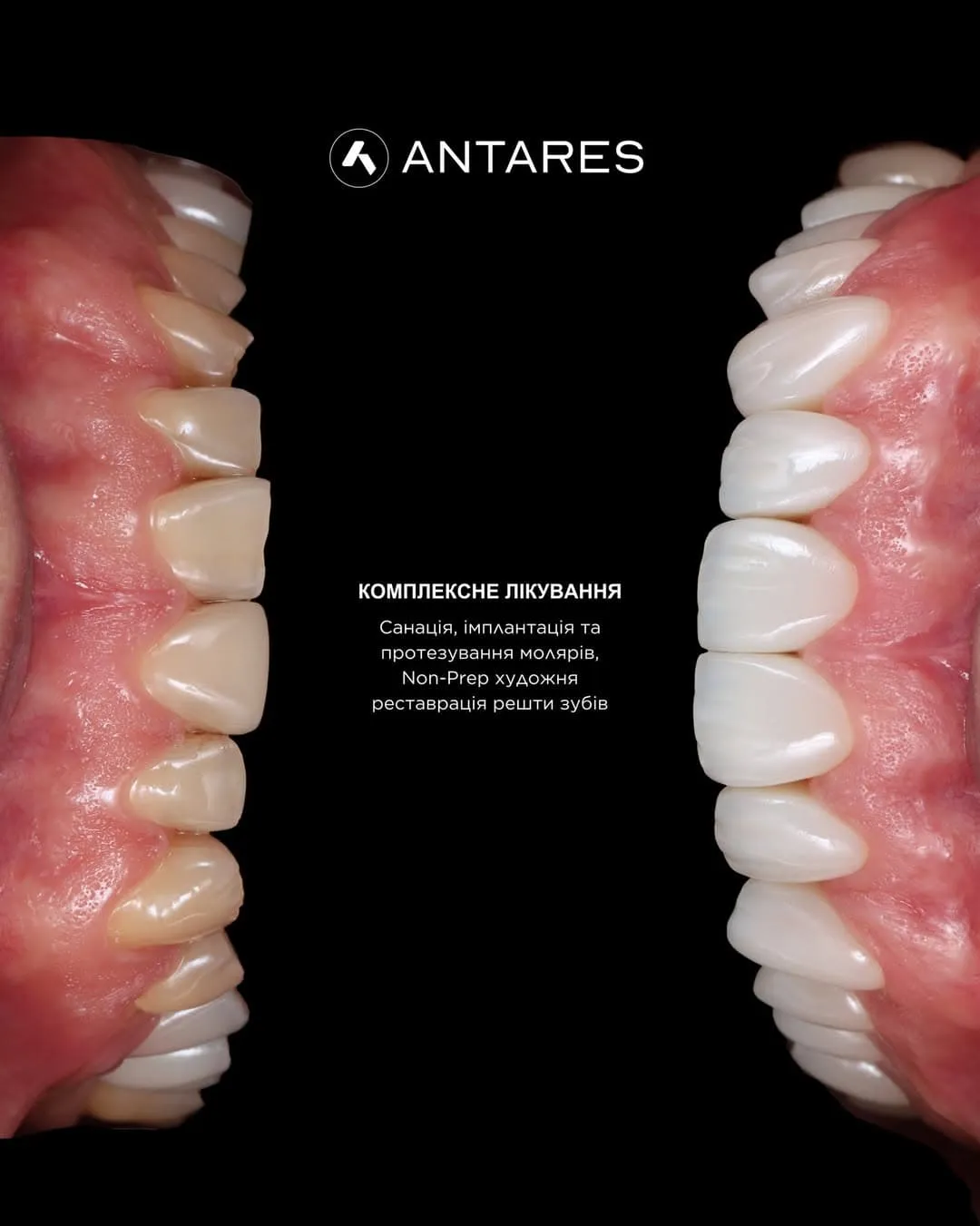
Dental Implants: A Modern Approach to Restoring Your Smile
What is dental implantation
A dental implant is a titanium element that is placed into the bone tissue and functions as a tooth root. After the implant integrates, an orthopedic restoration — a crown, bridge, or full denture, depending on the clinical situation — is affixed to it.
Modern implantation allows for:
- restoring chewing function;
- preserving adjacent teeth;
- preventing bone loss;
- restoring the natural aesthetics of your smile.
When is implantation recommended?
Implantation can be an optimal solution:
- for the loss of a single tooth;
- when several teeth are missing;
- in cases of complete tooth loss;
- for stabilizing full dentures;
- in cases where it's important to preserve adjacent healthy teeth.
A treatment plan is always developed individually after a comprehensive diagnosis.
How implantation is performed at Antares
Diagnosis and Planning
Treatment begins with a comprehensive examination:
- clinical examination;
- photographic documentation;
- computed tomography;
- bite analysis and bone tissue condition.
At this stage, a complete treatment plan is formulated, and the future outcome is predicted.
Preparation for Implantation
In some clinical situations, before implant placement, the following may be necessary:
- professional hygiene;
- cavity treatment;
- oral cavity sanitation;
- bone grafting or sinus lift.
The preparatory stage allows for the creation of stable conditions for implant integration.
Implant Placement
The procedure is performed under local anesthesia and is generally comfortable for the patient. The implant is placed into the bone tissue, taking into account anatomy, future load, and prosthetic planning.
Placement accuracy is critically important for a long-term outcome.
Integration Stage
After implant placement, time is needed for its integration with the bone tissue. The duration of this stage depends on the clinical situation and individual body characteristics.
Prosthetics
After integration is complete, a custom prosthetic restoration is fabricated.
The main goal is to restore:
- function;
- comfort;
- bite stability;
- natural dental aesthetics.
Is implant placement painful?
Modern anesthesia protocols ensure comfortable implant placement for patients. After the procedure, temporary discomfort or slight swelling may occur, which usually subsides within a few days. The doctor provides detailed recommendations for recovery and monitors the healing process.
Why a comprehensive approach is important
Successful implant placement isn't just about inserting an implant; it involves comprehensive planning of the function and aesthetics of the entire dentofacial system. At Antares, we pay attention to every stage of treatment — from diagnosis to final prosthetics — to ensure a stable, functional, and natural result for years to come.